
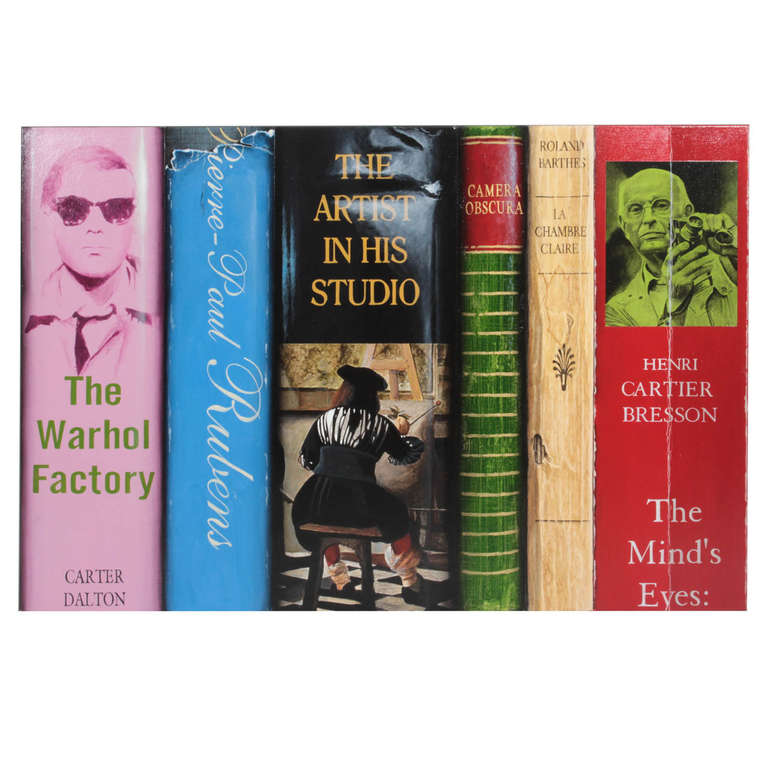


Product Description
Paul Beliveau Les humanites CCLXXXIX Hyperrealist painting 2007
PAUL BELIVEAU (1954-) Québec, Canada
“Les humanites CCLXXXIX” 2007
Acrylic on canvas
Signed and dated: Paul Beliveau 2007 (script signature on the back of canvas)
H: 40” x W: 60”
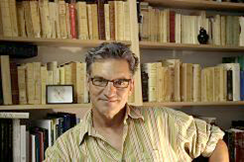
Born in 1954, Paul Béliveau attained his Bachelor’s degree in Visual Arts from Laval University in 1977. Recognized for his expertise in drawing, engraving and painting he has since then had more than sixty solo exhibitions across Canada and the United States. The recipient of numerous prizes in visual arts and of multiple grants from the Canada Council as well as the Ministère des Affaires Culturelles du Québec has taken part in several commitees and juries as specialist in the visual arts. “By openly integrating into the compositions an iconography from the past and proceeding through citation and retrospection, he reveals the phenomenon of metamorphosis upon which imagination itself is based. In this way he brings to light the very principles of the mechanics of creation. Imagination, which consists as it were in the transfer of a perceptible representation onto an image belonging to another reality, thus sees itself in the presented. Consequently it is not the images themselves but the unique process of creative development which accords Paul Béliveau’s works their originality.” (Dany Quine, L’oeuvre du temps)
Paul Beliveau Les humanites CCLXXXIX Hyperrealist painting 2007
You must be logged in to post a comment.
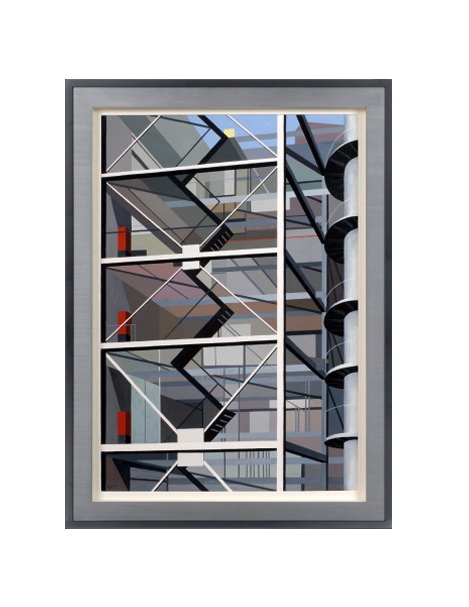
RICHARD HAROLD REDVERS TAYLOR (1900-1975) United Kingdom
Modernist building staircase c. 1949
Gouache on paper, metal and wood frame
Signed: RHRT (lower left)
Marks: Gimpel Fils exhibition label (on back)
Exhibited: “An Exhibition in the Kettle’s Yard Loan Gallery: Sculpture & Painter,
14 February – 10 March, 1972” Gimpel Fils, London
Framed: H: 41 7/16” x W: 30 5/16”
Richard Harold Redvers Taylor (1900-1975) was born in Brighton on March 14th, 1900 and educated at Brighton College and Heatherleys School of Fine Art, Chelsea. His father, Harold Taylor, was a headmaster. Redvers Taylor retired from the Army (where he specialized in topographical surveying in Africa) in 1937 but was recalled for war service. In 1946 he began a new career as a professional painter. Between 1948 and 1958 Taylor was given a series of six one-man shows by Lefevre and Gimple Fils in London. In the 1960’s he turned to sculpture, and in 1972 an exhibition of his sculpture and paintings was held at the Kettle’s Yard Loan Gallery in Cambridge. His work is held in the permanent collection at the Beith Uri V Rami Museum in Israel. Louise Taylor (née Hayden), his wife, was an American and the adopted daughter and heiress of Alice B. Toklas, the companion of Gertrude Stein. Louise Taylor died on 21 July 1977.
Purism, otherwise known as l’esprit nouveau was directly inspired by a spare, functionalist aesthetic and is closely associated with the work of Le Corbusier and his circle in Paris in the second quarter of the 20th Century. In America this purist style was known as Precisionism, which explored similar imaginary during the late 1920’s and 30’s with artists like Charles Sheeler, Charles Demuth and Ralston Crawford at the forefront of this movement. In England, the Vorticist movement (1912-1915) was founded by Wyndham Lewis and others and was the precursor to the Purist movement in Great Britain in the 1930’s and 1940’s. Redvers Taylor created geometrical landscapes while reducing volumes to colored planes and outlines to ridges. His artwork combines depth and perspective with flattened cubist fields of color. Architecture of industrial buildings was his favorite subject, whereas people and nature were usually absent from his compositions.
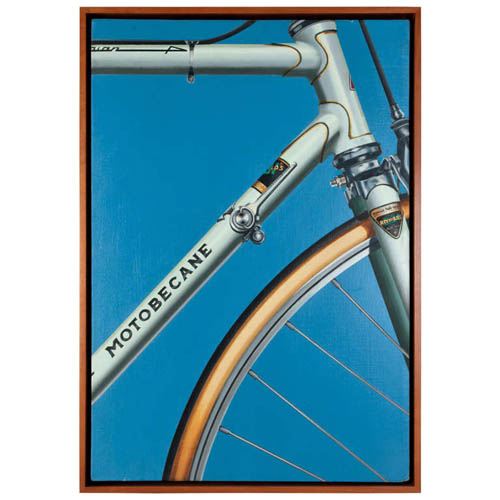
JEFFREY HARTMAN USA
“Motobecane” 1978
Oil on canvas
Signed: “Jeffrey Hartman ‘78”, “© 78 HARTMAN” (on the back)
Framed H: 26 1/2” x W: 18 1/2”
Price: $18,000
Belgian art dealer Isy Brachot coined the French word Hyperréalisme, meaning Hyperrealism, as the title of a major exhibition and catalogue at his gallery in Brussels in 1973. The exhibition was dominated by such American Photorealists as Ralph Goings, Chuck Close, Don Eddy, Robert Bechtle and Richard McLean; but it included such influential European artists as Gnoli, Richter, Klapheck and Delcol. Since then, Hyperealisme has been used by European artists and dealers to apply to painters influenced by the Photorealists. However, Hyperrealism is contrasted with the literal approach found in traditional photorealist paintings of the late 20th century. Hyperrealist painters and sculptors use photographic images as a reference source from which to create a more definitive and detailed rendering, one that often, unlike Photorealism, is narrative and emotive in its depictions. Strict Photorealist painters tended to imitate photographic images, omitting or abstracting certain finite detail to maintain a consistent over-all pictorial design. They often omitted human emotion, political value, and narrative elements. Since it evolved from Pop Art, the photorealistic style of painting was uniquely tight, precise, and sharply mechanical with an emphasis on mundane, everyday imagery. Hyperrealism, although photographic in essence, often entails a softer, much more complex focus on the subject depicted, presenting it as a living, tangible object. These objects and scenes in Hyperrealism paintings and sculptures are meticulously detailed to create the illusion of a reality not seen in the original photo. That is not to say they’re surreal, as the illusion is a convincing depiction of (simulated) reality. Textures, surfaces, lighting effects, and shadows appear clearer and more distinct than the reference photo or even the actual subject itself.
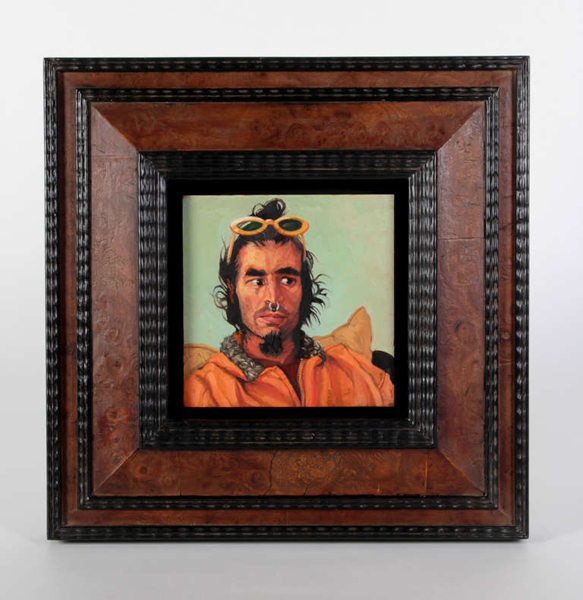
JACK RICHARD SMITH (1950-) Taos, NM
“Spiros Antonopoulos” 2004
Blackoil, wax, lead salts on copper, burl wood and ebonized wood Dutch old master style frame
Exhibited: “Taos Portraits” by Jack Smith, Harwood Museum of Art, University of New Mexico, Taos, New Mexico, May 14th – August 15th, 2004
Illustrated: “Taos Portraits” by Jack Smith, May 14th – August 15th, 2004, exhibition catalogue (Taos, NM: Harwood Museum of Art, University of New Mexico) illustr. 16
Painting: 6” x 6”
Framed: 13 3/4” x 13 11/16”
Price: $14,500
Incorporating blackoil, wax, lead salts, and copper Smith’s small format portraits and paintings are detailed and intimate depictions of creative individuals and charged tableaux. Smith’s singular style of portraits glow with a warm inner light and present honest, straightforward images that speak of personal narratives. Smith’s interest in miniatures developed first as a matter of convenience. In 1982, while preparing for a winter of travel in Mexico, he experienced logistical problems traveling with the larger size painting materials he was using at the time. The solution seemed to be a block of watercolor paper and casein, a milk base paint of versatile possibilities and vehement drying power. Suddenly, his paintings went from three by five feet to three by five inches. The history of oil painting, principally centered around the Dutch schools and their development of a method called black oil painting, often executed in miniature, also captured his interest. Black oil, an oleoresin comprised of white beeswax, raw linseed oil and litharge of lead, suspends the pigment above the painting ground, which was traditionally wood panel, linen or copper plate. This medium seems to suspend the pigment, allowing light to penetrate and reflect from the surface and illuminate the imaged from behind, a sort of light from within. The small format is an act of compression that requires the viewer to draw in close to a more intimate proximity and will, if the painting works, hopefully approach Joseph Campbell’s description of art as an “object of fascination” to engage the viewer and stop for a moment one’s busy mind. Jack Smith was born in 1950. At age 16, he began his training at the Interlochen Arts Academy in Michigan before moving to Ohio to attend Columbus College of Art and Design. He also studied for a brief time at the Instituto de Allende, at San Miguel de Allende, GTO, Mexico. He now resides in New Mexico. Reflecting a profound knowledge of art history and and an alchemist’s sense of the painting craft, contemporary painter Jack Smith has forged his own place amongst the most powerful of contemporary portraitists working in America. Jack Smith recently received a prestigious Past Achievement Award from the Peter and Madeleine Martin Foundation for the Creative Arts, following an important solo exhibition titled, Jack Smith: The Taos Portraits at the Harwood Museum of Art at the University of New Mexico in 2004. The exhibition featured fifty portraits of Taos, New Mexico residents, executed between 2000 and 2003. The series was intended as a visual biography of this unique artistic community at the turn of the century. Smith’s subjects range from the famous to the infamous — including artists, writers, art patrons, Native peoples, and street peoples. Spiros Antonopoulos’s (he always dropped the s in Spiros when saying his name) past is a little sketchy. I understand that he was trained as a musician and through that came to the world of computers, which he mastered immediately given his hot tub size brain pan. He also told me once that he had “done lots of drugs and some porn movies” while in college. Before we met he used to drive by my house in Arroyo Hondo, NM when he lived above us on the ridge road called Atalaya, about fifteen miles north of Taos and would make funny faces at me through the smudged window of his ghostly, lowrider station wagon. He was wildly eccentric dresser and had a selection of sunglasses that Elton would envy, mostly a thrift store wardrobe kind of guy. As I mentioned before, he tended to remind me of a mad computer geek samurai, which I tried to capture in this portrait. I’ve heard he now lives in the East Village and has forsaken his aforementioned life for obsessive Bikram yoga…… and that’s where the trail gets cold. The Taos portrait series was executed from 1999 to 2003 and was intended as a visual biography of this peculiar valley and town of Taos, NM. The subjects range from famous artists, writers and political activists to street people and what we affectionately call “sage bunnies”, or, folks that live out in the hinterlands in a grow hole with a goat or two and come to town once a month for provisions and bathe in patchuli oil, I presume, to save water. I would have liked to have had more of these folks but lining them up proved problematic as they tend to live in a parallel universe called locally, “the land of poco tiempo”, or “little time” , a condition caused, in their case, by smoking too much cheeba. This same time thing is true of my attempts at several more Native American friends from the pueblo…… it is something I greatly admire about them, unless of course you are scheduling a portrait sitting for the fourth time and they just had to go to Walmart without warning. But then “this is Taos” as John Nichols mentions in the forward to theexhibition catalogue and it is often referred to as an “open air asylum” for a myriad of good reasons. I thought it would be interesting to look back at some future time and see the weft and warp of the tapestry of Taos at the turn of themillennium. I could easily have done three hundred, but one must stop somewhere. The show was hanging in conjunction with Wayne Theibauld’s “City/ Country” exhibition at the Harwood Museum in Taos, New Mexico, June to September, 2004. – as told by Jack Smith, May 2006
 @hd_jewels
Reviews
There are no reviews yet, would you like to submit yours?