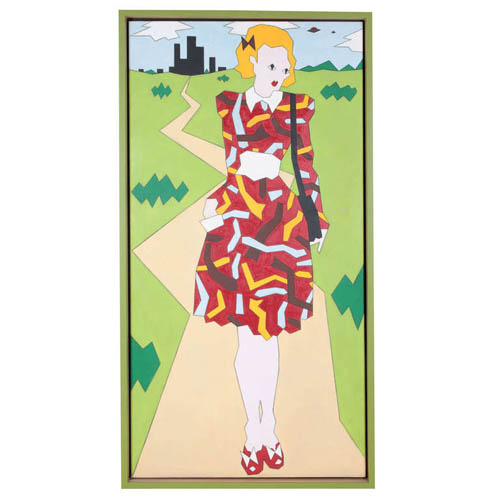
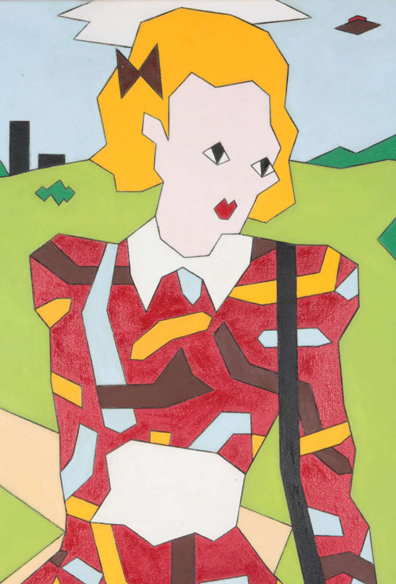
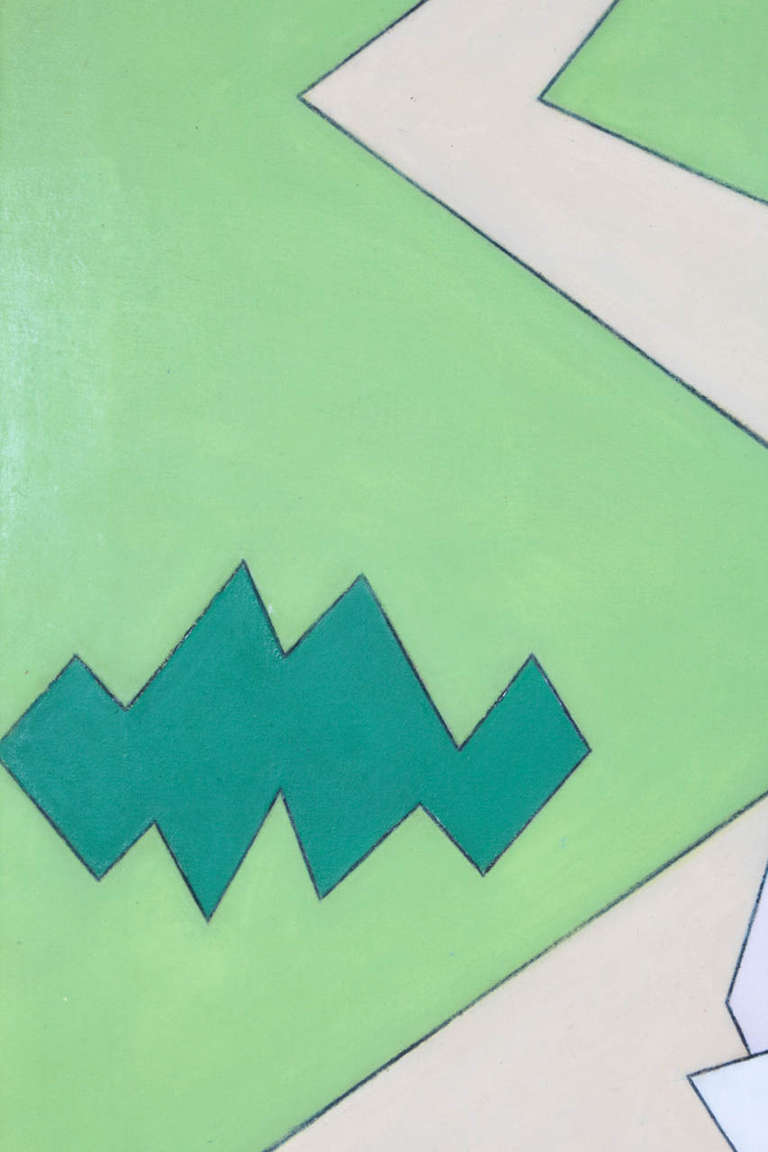
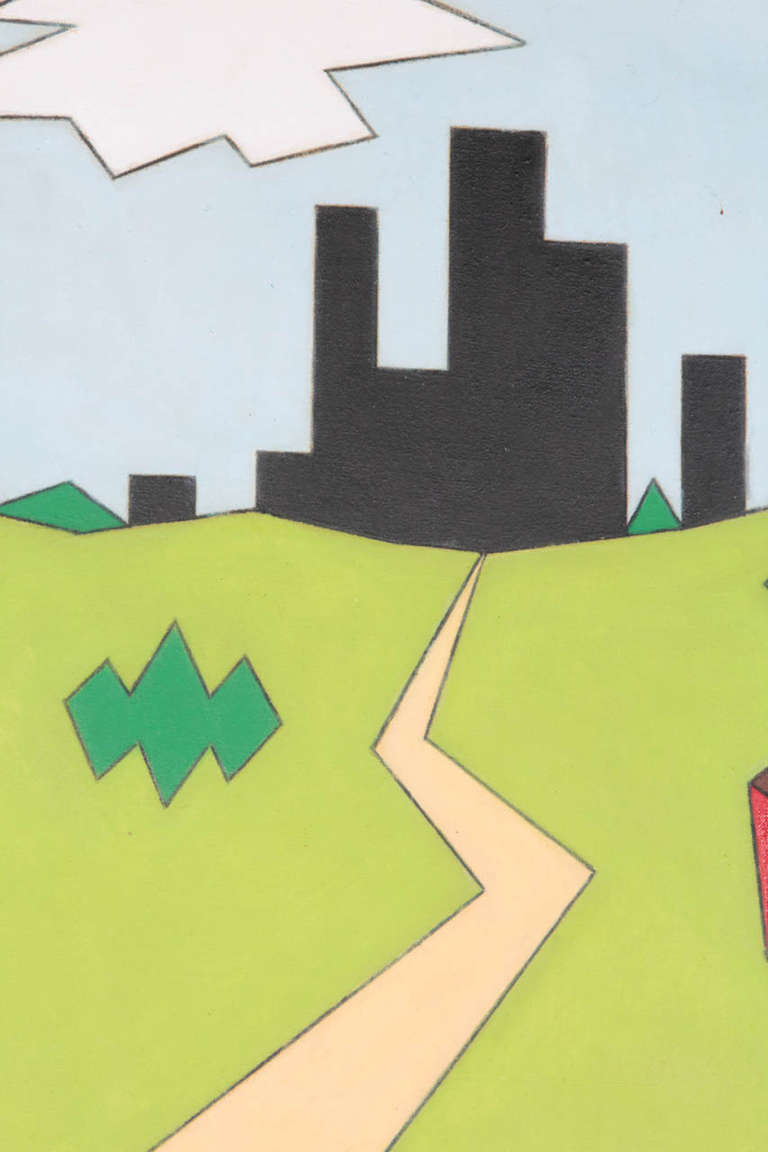
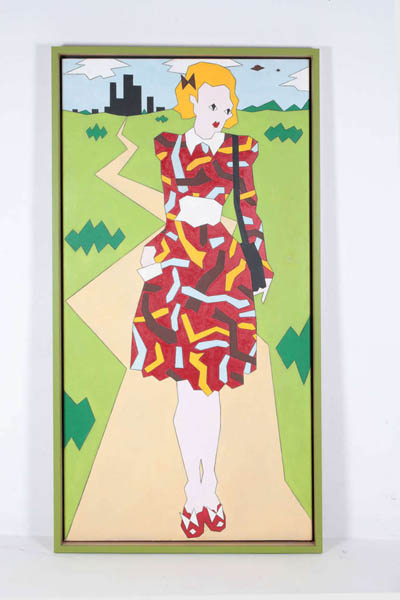
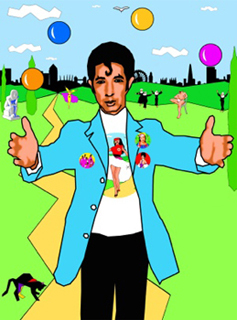
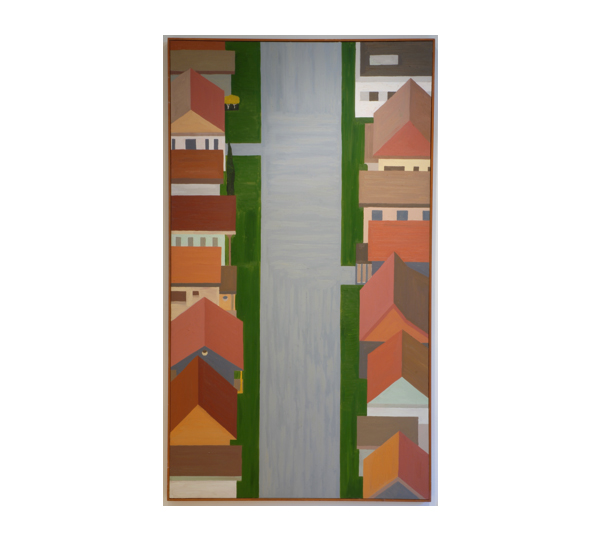
Duggie Fields "Girl with Shoulder Bag" Oil on linen 1970
More Information
Duggie Fields, “Girl with Shoulder Bag”, Oil on linen 1970
DUGGIE FIELDS (1945-) London, UK
“Girl with Shoulder Bag” 1970
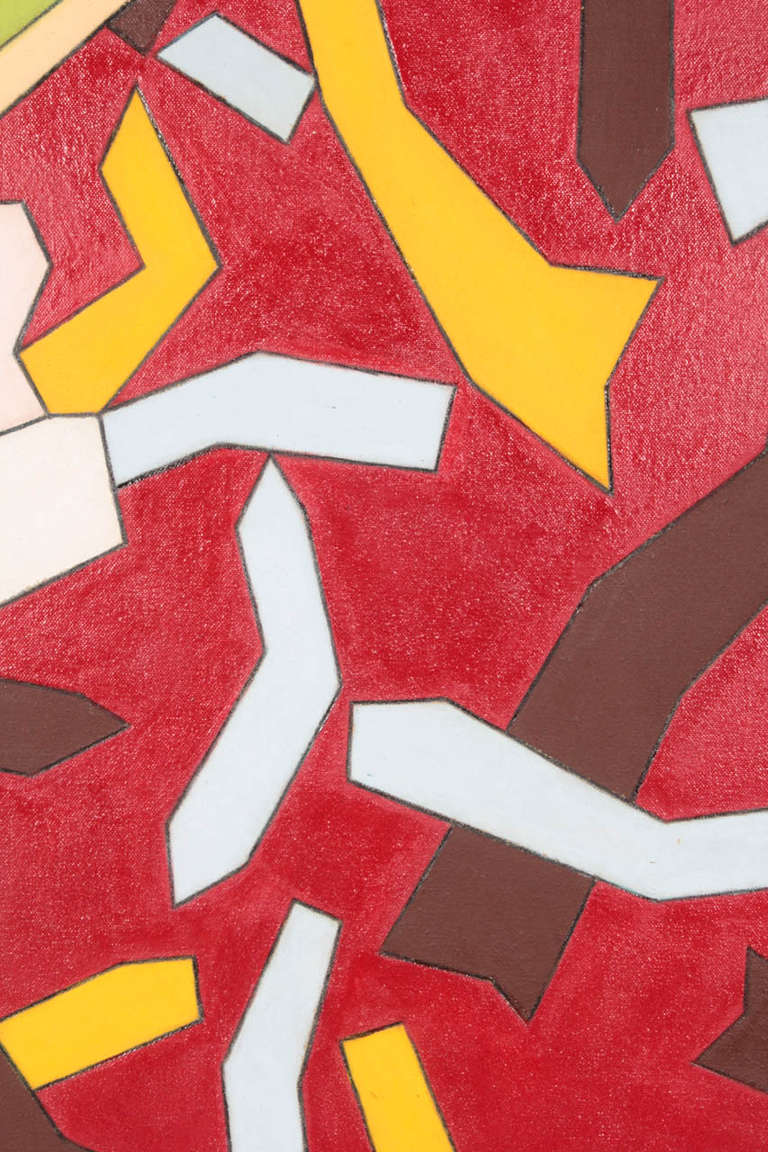
Oil on linen, custom wood and green lacquer Shadow box frame
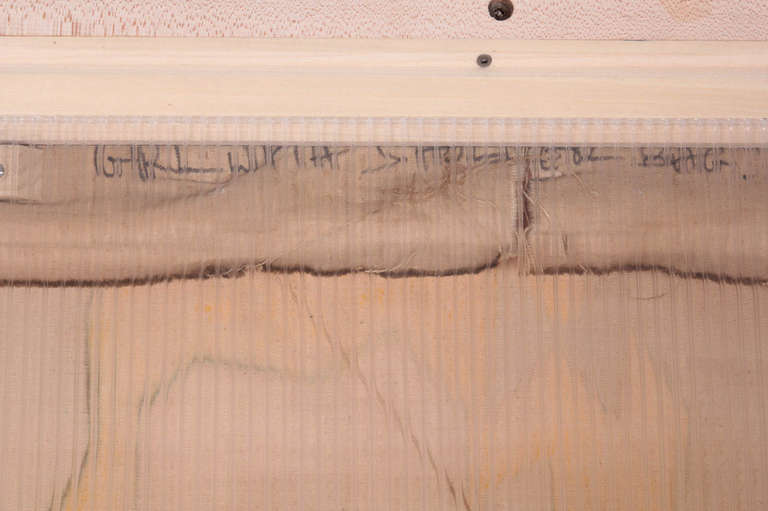
Marks: “Girl with Shoulder Bag”, Winter 1970 (Dougie Field)
Canvas: H: 72” x W: 36”
Framed: H: 74 1/2″ x W: 38 1/2″
Duggie Fields was born in 1945 and brought up in the village of Tidworth. He spent his youth in the countryside, moving to the outer suburbs of London in his adolescence. He studied architecture, briefly, at Regent Street Polytechnic before going to Chelsea School of Art in 1964 where he stayed for four years, before leaving with a scholarship that took him on his first visit to the United States. As a student his work moved from Minimal, Conceptual and Constructivist phases to a more hard-edge post-Pop figuration. By the middle of the 1970s his work included many elements that were later defined as Post-Modernism. In 1983 in Tokyo, sponsored by the Shiseido Corporation, a gallery was created specially for his show, and the artist and his work were simultaneously featured in a television, magazine, billlboard and subway advertising campaign throughout the country. He started working with digital media in the late 1990’s describing his work in progress as Maximalist. Selected One-Man Exhibitions 1971 Hamet Gallery, London 1972 Bear Lane Gallery, Oxford; 1975 Kinsman-Morrison Gallery, London 1979 Kyle Gallery, London; 1980 lkon Gallery, Birmingham; Midland Group, Nottingham; New 57 Gallery, Edinburgh; Roundhouse Gallery, London 1982 Spacex Gallery, Exeter; B2 Gallery London 1983 Shiseido Exhibition, Tokyo 1987 Albermarle Gallery, London 1991 Rempire Gallery, New York 2000 Random Retrospective, Virtual Gallery, DuggieFields Selected Group Exhibitions 1976 New London in New York, Hal Bromm Gallery, New York 1979 The Figurative Show, Nicola Jacobs Gallery, London; Masks, The Ebury Gallery, London; Culture Shock, The Midland Group, Nottingham; Art and Artifice, B2 Gallery, London 1983 Taste, Victoria and Albert Museum, London 1984 The Male Nude, Homeworks Gallery, London 1985 Image-Codes, Art about Fashion, The Australian Centre for Contemporary Art, Melbourne; VisualAid, Royal Academy, London l986 The Embellishment of the Statue of Liberty, Cooper Hewitt Museum/Barney’s New York 1987 Twenty Artists Twenty Techniques, Albemarle Gallery, London 1989 Fashion and Surrealism, Victoria and Albert Museum, London 1988 Het Mannelisknaakt, Gallery Bruns, Amsterdsm, St. Judes Gallery, London 1990 Universal Language, Rempire Gallery, New York 1993 Tranche d’Art Contemporain Anglais, Tutesaal, Luxemburg 1998 Exquisite Corpse, Jibby Beane, London 1999 Art 1999, Jibby Beane, London; Flesh, Blains Fine Art, London Nerve, I.C.A. London 2000 Art 2000, Jibby Beane, London Up &Co., New York
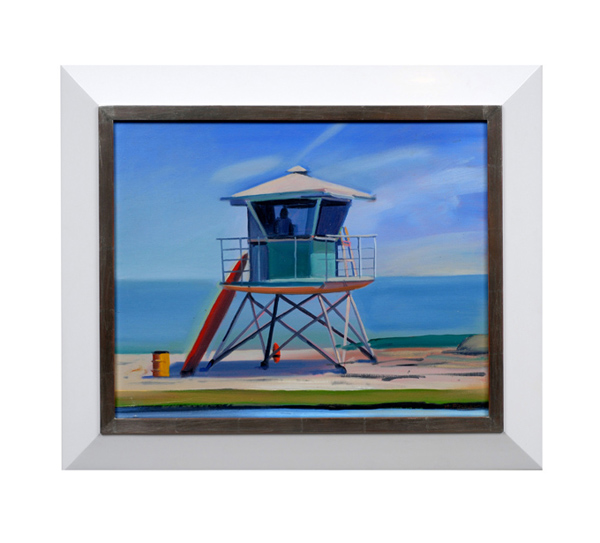
Hank Pitcher, “Life Guard Tower”, Oil on canvas c. 2002
HANK PITCHER (b. 1949) U.S.A.
“Life Guard Tower” c. 2002
Oil on canvas
Signed (on back)
For more information see: Hank Pitcher Surf, exhibit. cat. (Santa Barbara: Sullivan Goss Gallery, 2003); Surfboard Wax – A History, Jefferson “Zuma Jay” Wagner (Atglen, PA: Schiffer Publishing Ltd., 2005).
Canvas H: 15 7/8” x W: 19 7/8”
Framed: H: 21 3/8” x W: 25 3/8”
Pitcher’s surfboard paintings are the symbol of California beach culture…strong, definite, positive and euphoric statements about life in California. The surfboard’s power as totem is seen in its power to convey identity: surfer, Californian, Hank Pitcher. All are identifiable from this symbolic representation. Hank Pitcher is the voice of California culture. At the beach, in the surf, approaching the foothills, in the mountains, on the spit of Point Conception, in the crags of Big Sur, at a beach campfire in Santa Barbara, Pitcher paints the icons of California’s culture.
Hank Pitcher’s paintings are grounded in a particular sense of place. He was born in Pasadena, California on July 20, 1949, but his family moved to Isla Vista, near Santa Barbara, when he was two years old. When they came to Isla Vista it was an outpost on the beach, and Goleta was a farm town where kids rode their horses down the avenue to buy candy at the store. He was a football star at San Marcos High School and was recruited by big-name universities. Instead of football, he chose to attend the College of Creative Studies, an alternative program within the University of California at Santa Barbara (UCSB) where he now teaches painting. He splits his time between painting and surfing, pursuing each with the commitment and energy of a linebacker.
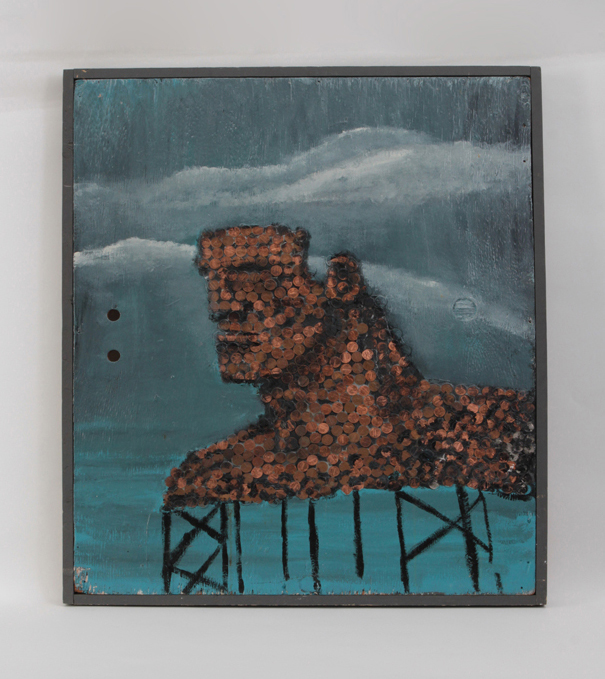
Robert Loughlin, “The Founder of the Empire”, Oil paint and pennies on plywood panel 1985
For more information on Robert Loughlin see: http://www.nytimes.com/2015/10/02/fashion/mens-style/the-legacy-of-robert-loughlin-artist-behind-the-brute.html?mwrsm=Email
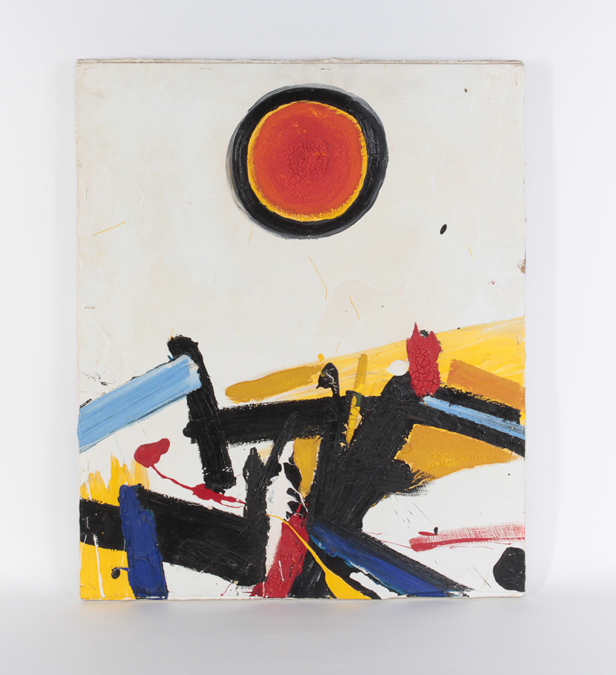
Signed: Napoli (scrafitto on front), Giuseppe Napoli 1965 “Shamballa”
(on back of board), Giuseppe Napoli (signed twice on stretcher)
H: 24” x W: 20”
A profoundly dynamic Abstract Expressionist painting by New York artist, Giuseppe Napoli. The painting is painted on board which is affixed to stretcher bars by staples.
Giuseppe Napoli was part of the New York School of the 1950’s and 60’s working out of a small studio in Greenwich Village. Napoli participated in numerous exhibitions but unfortunately his career was cut short by his suicide in 1967 the result of suffering from periods of depression.
Just as “Starry Night” is widely considered to have reflected the mental state of Van Gogh shortly before his death; this painting may also have reflected the mental state of Giuseppe Napoli who ended his own life only two years after creating this remarkable painting. The vigorous, heavy impasto, the ominous sun made impotent by the bold black ring that surrounds it and the jumbled landscape below, could be symbolic of the hope-against-hope, that eventually prevailed.
Illustrated: Nach Schiele, Tobias G. Natter and Thomas Trummer (Köln, Germany: Atelier Augarten, DuMont, 2006), p 142.
Provenance: Private Collection Vienna
For related works by Hubert Schmalix see: Hubert Schmalix, Lóránd Hegyi exhibition catalog (Museum Moderner Kunst StiftungLudwig Wien) November 19, 1994 – January 1995.
H: 85” x W: 49”
Hubert Schmalix was born in Graz, Austria, on December 17, 1952 and studied at the Vienna Art Academy from 1971 to 1976. By 1979 Schmalix was showing work at the forward-looking exhibition ‘Europa 79 – Kunst der 80er Jahre’ in Stuttgart. In 1983 the London Tate Gallery invited Schmalix to present work at ‘New Art’, an important survey of contemporary art. Schmalix has become well-known world-wide as an exponent of ‘New Art’, working with a retrospective glance at both classical art history and modern art. Schmalix focuses on the world of things and the human figure. Although the expressive gesture was the dominant feature of his 1980s work, it yielded early in the 1990s to stringent tectonic composition. In 1984 Hubert Schmalix went to the Philippines and on to the US, moving to Los Angeles in 1987. In 1986-87 Schmalix taught at the Academy for the Decorative and Applied Arts in Vienna and from 1997 he has been a professor at the Vienna Art Academy. Schmalix is a visiting professor at the University of California Los Angeles (UCLA). In 1993 his work was featured at the Venice Biennale and in 1998 he was awarded the Fine Art Prize of the City of Vienna. Schmalix has done several large fresco cycles in Salzburg and his work has been shown extensively at numerous international solo and group shows and most recently at Art Basel 2006.
The Kunstforum in Vienna is dedicating a major retrospective show to Hubert Schmalix from May 6th – July 12th, 2015.
“I’m not nervous or angry when I paint, but well rested and concentrated. Each stroke of the brush is important! I’ve painted a whole lot of beautiful pictures this way.” (Hubert Schmalix)

 @hd_jewels
Reviews
There are no reviews yet, would you like to submit yours?