Product Description
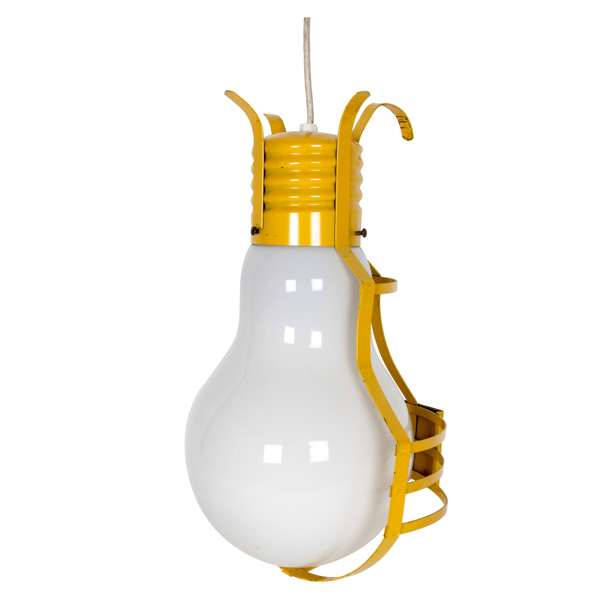
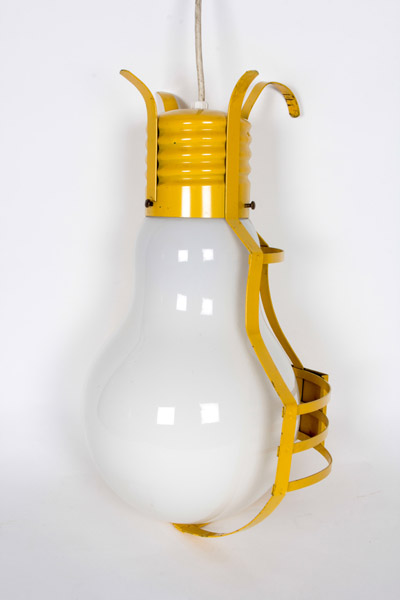
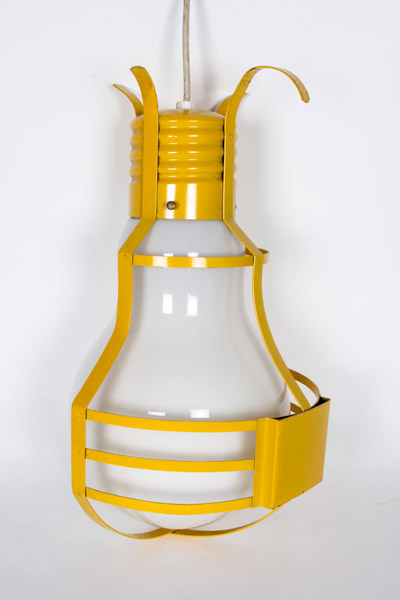
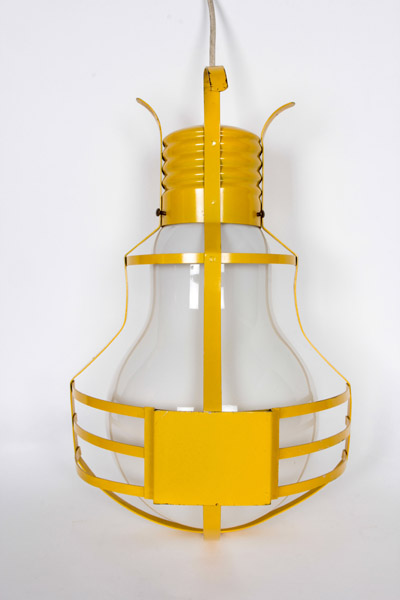
Italian Design “Pop-Art” Oversized “Anywhere” Lamp c. 1960’s-1970’s

ITALIAN DESIGN / POP ART
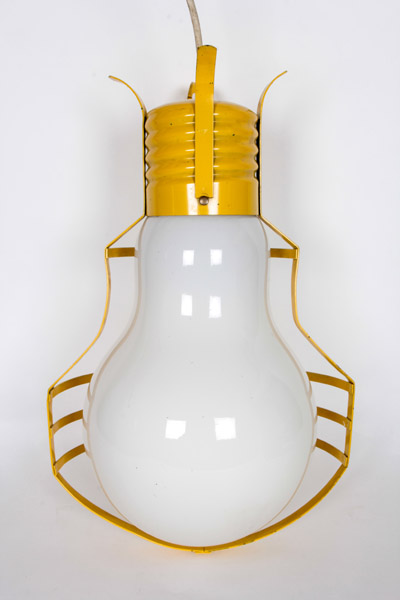
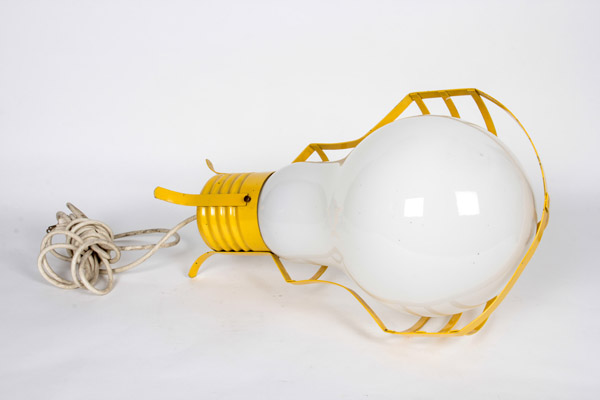
“Oversized “anywhere” lamp circa 1960’s-1970’s.
Real blown glass bulb with a yellow metal “protector” paying homage to the classic “anywhere” work light. It is interesting to note that at a later date Ingo Maurer who designed the famous “flying bulb lights” used this light as an inspiration and did a paired down simple version utilizing plastic rather than glass for the actual glass bulb part.
H: 19″ X W: 11 1/2″
Price: $2,450
Italian Design “Pop-Art” Oversized “Anywhere” Lamp c. 1960’s-1970’s
MARCEL WANDERS (1963-) The Netherlands
“One morning they woke up” mosaic occasional table or stool 2004
Gilt and lively colored glass mosaic, fiberglass body
H: 13″ x D: 17″
Price: $18,500
Marcel Wanders (1963) grew up in Boxtel, the Netherlands, and graduated at the School of the Arts Arnhem in 1988 with a cum laude certificate. He is now an independent industrial product designer operating out of Amsterdam where he has his own studio, Marcel Wanders studio. Marcel continues to work on diverse products and projects for Cappellini, Mandarina Duck, Magis, Droog Design and Moooi amongst others. For the latter he is associated as creative director. Marcel also co-operates in other design-related projects, such as the Vitra Summer Workshop where he was project leader for the second time. Also he was a juror for various prizes like the Rotterdam Design Prize (for which his own products were nominated several times) and the Kho Liang Ie prize. He lectured at SFMoMA, Limn the Design Academy and has taught at various design academies in the Netherlands. Marcel won the Rotterdam Design Prize (public prize) for the Knotted Chair, and received several other awards including the George Nelson Award (Interiors magazine) and Alterpoint Design Award 2000. In the 2001, Marcel has been nominated in the category ‘designer of the year’ in WIRED magazine’s 2001 wired rave awards. Designs of Marcel Wanders have been selected for the most important design collections and exhibitions in the world, like the Museum of Modern Art in New York and San Francisco, the Stedelijk Museum in Amsterdam, Museum Boijmans van Beuningen in Rotterdam, the Central Museum in Utrecht, and various Droog Design exhibitions. In the book ‘Wanders Wonders, design for a new age’ (1999) which accompanied a solo exhibition in Museum ‘t Kruithuis in Den Bosch, the most important products are shown, from the Knotted Chair to the Shadows lamps and from the Nomad Carpet to the Eggvase. Works of Marcel have been published in all leading design magazines.
Andrea Branzi (1938 – ) Zabro, Italy.
“Cucus” chair c.1985
Lacquered wood, tree branches
Illustrated: Domestic Animals: The Neoprimative Style Andrea and Nicoletta Branzi, (London, 1987) n.p.; Designed by Architects in the 1980s, Julie Capella and Quim Larrea, Barcelona, 1987, p. 37; Anne Bony, Paris Les années 80, 1995, p. 520; Charlotte and Peter Fiell, 1000 Chairs, Cologne, 2000, p. 588
H: 42 3/4″ x W: 19 3/4″ x D: 24″
Price: $19,000
The “Cucus” chair was part of the “Domestic Animals” series
designed in 1985/86 by Andrea Branzi for Zabro.
Andrea Branzi's “Domestic Animals” series was designed in 1985 and 1986 for the Italian firm Zabro. Designs were later also manufactured by Zanotta. Andrea Branzi created “Domestic Animals” in collaboration with Nicoletta Branzi, who produced limited edition art clothing for this series. The “Neoprimitive” style in which this collection has been rendered utilizes natural materials such as sticks to create an object that brings archetypal symbols into the home to produce emotional effects. These objects combine technology and nature and the symbols and codes that these entail demonstrating that “a hybrid love between different creatures is possible.” (Branzi, Domestic Animals, 1987, n.p.) With these objects Branzi aims to “domesticate” technological inventions so as to make them a positive presence in man's life.
“The difference between a domestic animal and a trained (or tamed) one lies in the fact that the latter is the outcome of an unnatural and violent attitude, while the domestic animal establishes the dream of a loving relationship with man.” (Branzi, Domestic Animals, 1987, n.p.)
Andrea Branzi, architect and designer, born in Florence in 1938, where he graduated in 1967, lives and works in Milano. From 1964 to 1974 he was a partner of Archizoom Associati, first vanguard group internationally known, whose projects are preserved at Centro Studi e Archivio della Comunicazione in Parma and at Centre Georges Pompidou in Paris.
Since 1967 he works in the fields of industrial and research design, architecture, urban planning, education and cultural promotion.He is Professor at the Third Faculty of Architecture and Industrial Design of Politecnico di Milano.
CHRISTOPHER DRESSER (1834-1904) UK
HEATH & MIDDLETON Birmingham, England
Petite claret jug 1887
Sterling silver mounts with hinged covers to both top and spout, glass, ebony handle
Marks: JTH & JHM in a four-lobed cartouche, London assay marks for 1887 (“M” in a shield), Vienna import mark (conjoined AV in a 6-sided cartouche)
Illustrated: Industrial Design Unikate Serienerzeugnisse, Die Neue Sammlung ein neuer Museumstyp des 20. Jahrhunderts, Hans Wichmann (Munich: Prestel-Verlag, 1985), p. 131; Christopher Dresser, ein Viktorianischer Designer, 1834-1904 (Cologne: Kunstgewerbemuseum der Stadt Köln, 1981), p. 73, ill. 86, cat. no. 23; Industrial Design, John Heskett (New York and Toronto: Oxford University Press, 1980), p. 24, illus. 9; Christopher Dresser 1834-1904, Michael Collins (London: Camden Arts Centre, 1979), p. 171, cat.no.12.
H: 6” x Dia: 4”