Asprey & Co., Important Cardinal Sculpture gem set with natural rubies, 18K gold and amethyst quartz, signed,1980
ASPREY & CO. LTD. (founded 1781) London, UK
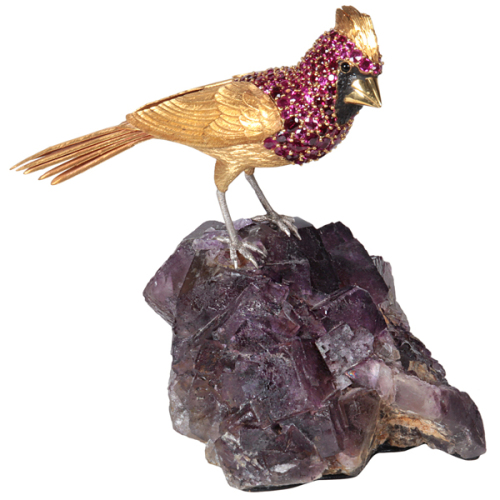
Important Natural Ruby Gem Set 18K Gold Cardinal Bird Sculpture 1980
Finely chased and chiseled 18K yellow and white gold realistically rendered sculpture of a Cardinal bird set with
85+ carats (approx.) of natural gem quality oval and round cut Burmese rubies (GIA certificate) further heightened with enamel eyes and blackened gold face plumage details, the 18K gold and natural ruby cardinal sets atop a natural Amethyst crystal “mountain rock” with a tooled and gilt (script mark) on the leather under-pad.
Marks: A & Co. (in a quatrefoil), Crown mark, 750 (gold standard mark) Lion’s head (London assay mark) “F” date mark for 1980, tooled and gilt Asprey (script mark) on the leather under-pad
Provenance: Privately commissioned by the Sultan of Brunei’s younger brother, Prince Jefri Bolkiah who also later became the owner of Asprey & Co in the 1995. This rare sculptural 18K gold and natural ruby Cardinal was handmade by the finest jewelers and work masters in the workshop of the London Asprey & Co. located above the flagship store at 167 New Bond Street.
H: 3 ¾” x L: 5 3/4” x W: 1 ½”(Cardinal only)
H: 6” x W: 6 ¾” x D: 5 ¾” (with Cardinal atop natural Amethyst crystal rock)
As one might guess, a large part of the animal symbolism of the cardinal comes from the brilliant red color of the males. In fact, its name is derived from the royal red vestments worn by Catholic cardinals. This shock of red, especially against the stark backdrop of winter snow, is a magnificent sight. The male cardinal reminds us passion, warmth and vibrancy is available to us – even under the cloak of Winter’s grey clouds. Interestingly, the more bold and bright his color is, the more successful the cardinal will be at prolonging his lineage. Dull colored male cardinals are less likely to mate successfully than bright colored ones. True to the fire of his color, the crimson cardinal has got some major spunk. He will aggressively defend his territory, and fight attackers with ferocity. Indeed, they have been known to fight ghost males (their reflections) in mirrors for hours on end. Both male and female give us glorious songs. Along with peeps and pips and warbles, the tuned ear can also hear “cheer, cheer, cheer!” Very appropriate to the animal symbolism of cardinals, because they are a delight to both eyes and ears. The cardinal makes a fantastic animal totem. It reminds us to hold ourselves with pride, not ego pride but rather the cardinal asks us to stand a little taller, be a bit more regal and step into our natural confidence as if we were born to lead with grace and nobility. Those who attract the cardinal as their totem are naturally energetic, love life, and happily help others where and when they can!
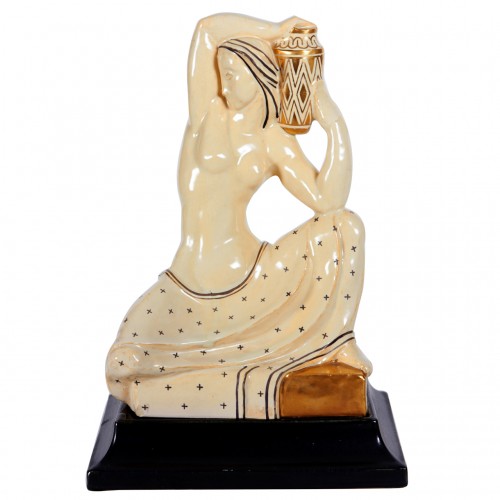
Walter Paul Suter, American Art Deco glazed pottery sculpture 1929
WALTER PAUL SUTER USA
AMERICAN ENCAUSTING TILING CO. New York, NY
Art Deco Seated Female Figure with Draped Skirt and Holding an Art Deco Vase 1929
Hand-modeled and molded cream glazed earthenware figure with gold and silver details on a separate, but matching black glazed earthenware base.
Signed: SUTER ‘29 (under glaze on back right hand corner)
H: 13″ x D: 7 1/2″ x W: 9″
Price: $14,500
Walter Paul Suter was born inBasel, Switzerland in 1902 and studied there at the School of Fine and Applied Arts. He moved to the United States in 1924 and settled in New York. He was a member of the American Ceramic Society, as well as the Society of Swiss Painters, Sculptors & Architects. In 1932 Suter won first prize in the Robineau Member Exhibition in Syracuse. He was a member of the American Encaustic Tiling Company in NYC.
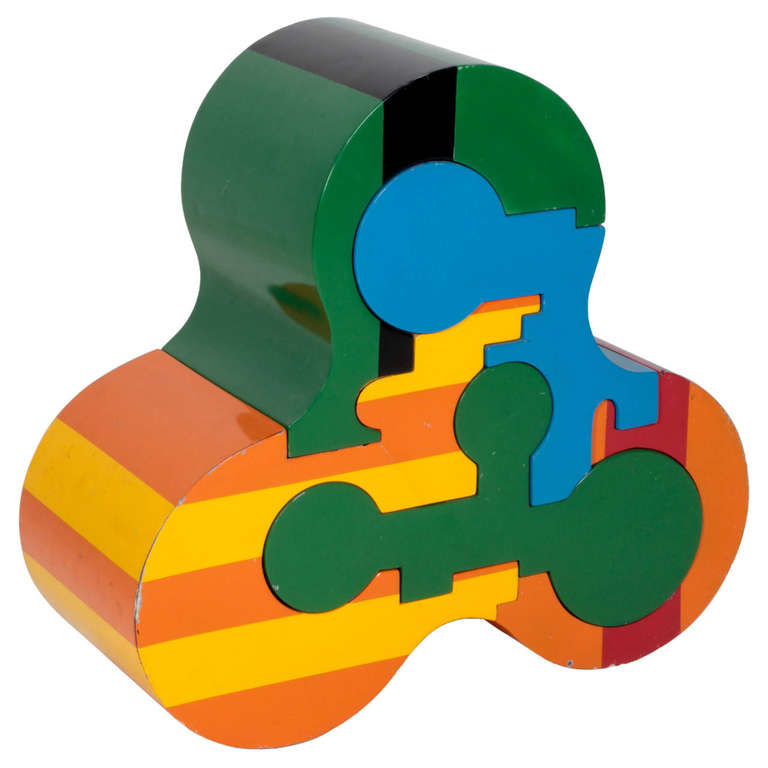
Lacquered PVC in a rounded movable puzzle form with interlocking pieces.
H: 24 1/2″ x L: 26″ x D: 11″ (closed)
H: 24 1/2″ x W: 26″ x D: 11″
Price: $24,000
Guy de Rougemont is a French painter and sculptor and is famous for his use of vibrant geometric motifs. His works are a perfect blend of pop art and minimalism. In 1990, the Musée des Arts Décoratifs in Paris (Museum of Decorative Arts) presented an important retrospective about this major contemporary French artist, member of the prestigious French Académie des Beaux-Arts. ROUGEMONT, Espaces publics et Arts décoratifs, 1965-1990, Musée des Arts décoratifs, Paris, 5/22/1990 – 08/19/1990




 @hd_jewels
Reviews
There are no reviews yet, would you like to submit yours?