Product Description
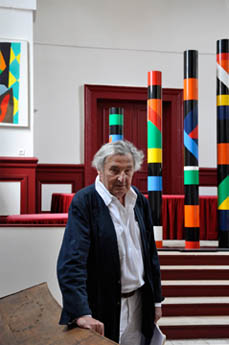
Guy de Rougemont Puzzle Sculpture c. 1970

GUY DE ROUGEMONT (b. 1935) Paris, France
“Puzzle” sculpture c. 1970
Lacquered PVC in a rounded movable puzzle form with interlocking pieces.
H: 24 1/2″ x L: 26″ x D: 11″ (closed)
H: 24 1/2″ x W: 26″ x D: 11″
Price: $24,000
Guy de Rougemont is a French painter and sculptor and is famous for his use of vibrant geometric motifs. His works are a perfect blend of pop art and minimalism. In 1990, the Musée des Arts Décoratifs in Paris (Museum of Decorative Arts) presented an important retrospective about this major contemporary French artist, member of the prestigious French Académie des Beaux-Arts. ROUGEMONT, Espaces publics et Arts décoratifs, 1965-1990, Musée des Arts décoratifs, Paris, 5/22/1990 – 08/19/1990
Guy de Rougemont Puzzle Sculpture c. 1970
KARL SCHMIDT (b. 1948) Vienna
HAGENAUER WERKSTÄTTE Vienna
Sculpture c. 1965
Handwrought sterling silver repoussé in the form of a nude with blowing hair
Marks: SCHMIDT WIEN MADE IN AUSTRIA 925 (silver standard) KS (artist initials)
For more information see: Metallkunst, Karl H. Bröhan (Berlin: Bröhan Museum, 1990) pp. 200-205; Werkstätte Hagenauer 1898-1956, (Vienna: Österreiches Museum für angewandte Kunst).
H: 17 1/4″ x W: 12″ x D: 2 3/4”
Price: $17,500
SALVATORE MELI (b. 1929) Italy
Important Sculpture / Ewer 1952
Glazed terra cotta, brown and dark green with white scraffito decoration, original stepped and angular wood base.
Signed: Meli 1952 Roma
For more info on Meli see: Design 1935-1965, What Modern was, ed. Martin Eidelberg (New York: Harry Abrams, 1991) p. 237.
Salvatore Meli belongs to that initial group of artists, including Guido Gambone and Lucio Fontana among others, who elevated Italian ceramics to a fine art during the post-war period. Meli conceived this vessel, first on paper, then by laboriously constructing the body in clay, coil by coil, to achieve the richly textured and dynamic form; the incised and painted decoration is in concert with the organic shape. The massive scale of this work defies function as a ewer but was created as a sculptural object. The original wooden base recalls Italian futurist sculpture forms of the early twentieth century.
H (with base): 23 1/2” x W: 13” x D: 9.5”
H (without base): 19 1/8”
Price: $27,500
African Bronze “Tree of Life” Sculpture 20th Century
Sand cast bronze with a brown black patina with golden highlights in an open work design depicting 18 figures perched on a tree form with various intricate pattern details.
***As a Primitive / Tribal sculpture this piece visually relates to some of the sculpture and painting of the renowned French artist Jean Dubuffet.
H: 18 1/2″ x D: 4″ x W: 8″
AZTEC AD 1325-1475 Mexico.
Important stone carved sculpture of a coiled serpent, AD 1325-1475 Mexico.
***Two scientific authentication reports are available with this sculpture.
H: 10″ x D: 8″
The serpent played a very important role in Aztec religion and was represented in a variety of forms. The majority of the serpents represented in Aztec sculpture are rattlesnakes.
Mexican mythology indicates the snake is a symbol of veneration, worship and honor. Often a symbol of great power, resurrection and rebirth, the snake continues to be a powerful emblem of renewal and transition.
Further, the snake is recognized as a symbol of humanity as a whole. Interestingly, the Mexican perspective provides hope for mankind to aspire to great heights as it correlates the shedding of the serpent’s skin to man’s ability to change his own circumstances and overcome adversity.
The Aztecs build an impressive empire in the valley of Mexico. This thriving area, known as Tenochitlan, was the cultural, religious and trading center of Mesoamerica. Aztecs were the Native American people who dominated northern Mexico at the time of the Spanish conquest led by Hernan Cortez in the early 16th century. According to their own legends, they originated from a place called Aztlan, somewhere in north or northwest Mexico. At that time the Aztecs (who referred to themselves as the Mexica, or Tenochca) were a small, nomadic, Nahuatl-speaking aggregation of tribal peoples living on the margins of civilized Mesoamerica. Sometime in the 12th century they embarked on a period of wandering and in the 13th century settled in the central basin of México. Continually dislodged by the small city-states that fought one another in shifting alliances, the Aztecs finally found refuge on small islands in Lake Texcoco where, in 1325, they founded the town of Tenochtitlan (modern-day Mexico City). The term Aztec, originally associated with the migrant Mexica, is today a collective term, applied to all the peoples linked by trade, custom, religion, and language to these founders. Warriors and pragmatic builders, the Aztecs created an empire during the 15th century that was surpassed in size in the Americas only by that of the Incas in Peru. As early texts and modern archaeology continue to reveal, beyond their conquests and many of their religious practices, the Aztecs had many positive achievements: the formation of a highly specialized and stratified society and an imperial administration, the expansion of a trading network as well as a tribute system, the development and maintenance of a sophisticated agricultural economy (which was carefully adjusted to the land) and the cultivation of an intellectual and religious outlook that held society to be an integral part of the cosmos.