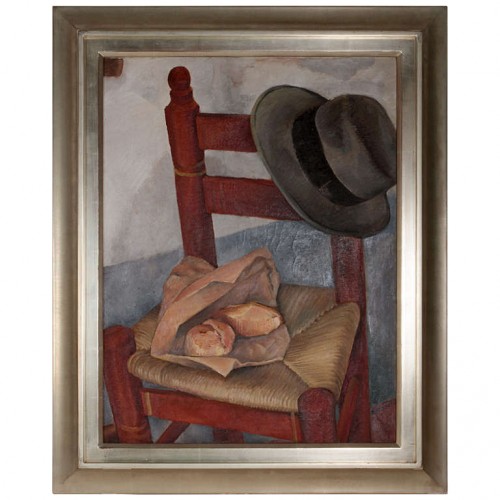
Victor Arnautoff, The Felt Hat, Oil on Canvas c. 1930
VICTOR ARNAUTOFF (1896-1979) USA
The Felt Hat c. 1930
Oil on canvas, white gold frame
Signed: V. Arnautoff, lower right
Exhibited: Art Center San Francisco, 1931 (see image of the review in the San Francisco Examiner, July 12th, 1931)
For more information see: The New Deal for Artists, Richard D. McKinzie (Princeton, NJ: Princeton University Press, 1973), Coit Tower, San Francisco : Its History and Art
Painting: H: 26” x W: 21”
Framed: H: 32 ½” x 27 ½”
Price: $60,000
Victor Arnautoff created paintings and watercolors, focusing on portraits, still lifes and rural landscapes in his early years, and moved to more socially conscious themes later in his career. Arnautoff was a native of Russia, to which he returned during the 1960s after thirty years in the United States. He came to San Francisco from Russia via China, bringing his wife and children with him, and studied at the California School of Fine Arts studying with Ralph Stackpole and Edgar Walter before going to Mexico. There he worked as an assistant to the famous Mexican muralist Diego Rivera. During the 1930s, Arnautoff worked as project director and one of the artists selected to create the famed Coit Tower murals, he played a key role in determining the political and social content of the frescoes painted in the San Francisco landmark. His own contribution, City Life, appears to be a lively, non-political melding of downtown San Francisco scenes; however, closer study reveals two leftist newspapers on the newsstand, while the city’s most mainstream daily, the San Francisco Chronicle, is strangely missing. Arnautoff also painted frescoes in the Military Chapel at San Francisco’s Presidio, in the Anne Bremer Library of the San Francisco Art Institute, and in high schools and other buildings in the Bay Area. He was a professor of art at Stanford University from 1939 until his retirement in 1963.
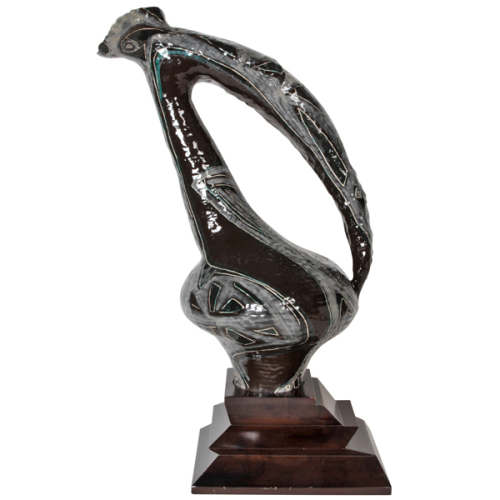
Salvatore Meli Important large scale Italian Sculpture / Ewer 1952
SALVATORE MELI (b. 1929) Italy
Important Sculpture / Ewer 1952
Glazed terra cotta, brown and dark green with white scraffito decoration, original stepped and angular wood base.
Signed: Meli 1952 Roma
For more info on Meli see: Design 1935-1965, What Modern was, ed. Martin Eidelberg (New York: Harry Abrams, 1991) p. 237.
Salvatore Meli belongs to that initial group of artists, including Guido Gambone and Lucio Fontana among others, who elevated Italian ceramics to a fine art during the post-war period. Meli conceived this vessel, first on paper, then by laboriously constructing the body in clay, coil by coil, to achieve the richly textured and dynamic form; the incised and painted decoration is in concert with the organic shape. The massive scale of this work defies function as a ewer but was created as a sculptural object. The original wooden base recalls Italian futurist sculpture forms of the early twentieth century.
H (with base): 23 1/2” x W: 13” x D: 9.5”
H (without base): 19 1/8”
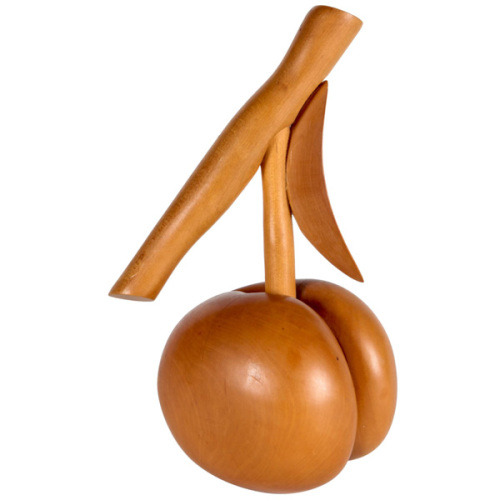
Jan de Swart, Handcarved “Peach” Sculpture, c.1970
JAN DE SWART (1908-1987) Netherlands / USA
Peach sculpture c. 1970
Hand carved and formed jelutong wood in a symbolic / erotic form of a peach
For more information see: Jan de Swart: A Day That Becomes a Lifetime, exhibition catalogue (California: Fine Arts Gallery at the San Fernando Valley State College, February 1972); Jan de Swart, Mike McGee and William G. Otton (Laguna Beach, California: Laguna Art Museum, 1986).
H: 7 ½” x D: 4”
Price: $7,500
Constantly seeking and inventing new materials Jan de Swart was a true modernist. He was influenced by artists such as Isamu Noguchi, Harry Bertoia, Charles Eames, and later Sam Maloof and Wendell Castle. Although he had been creating small sculptures since his arrival in California from Holland in 1929, he had not been widely recognized until being introduced to John Entenza, publisher of Arts & Architecture magazine in 1947. Soon thereafter, he was able to create larger works and began collaborating with architects such as Whitney Smith and Victor Gruen on special commissions. His work is in the permanent collection of Los Angeles County Museum of Art, The Smithsonian, and the Ford Foundation. He was honored with the American Institute of Architects Gold Medal for Sculpture in 1965.



 @hd_jewels
Reviews
There are no reviews yet, would you like to submit yours?