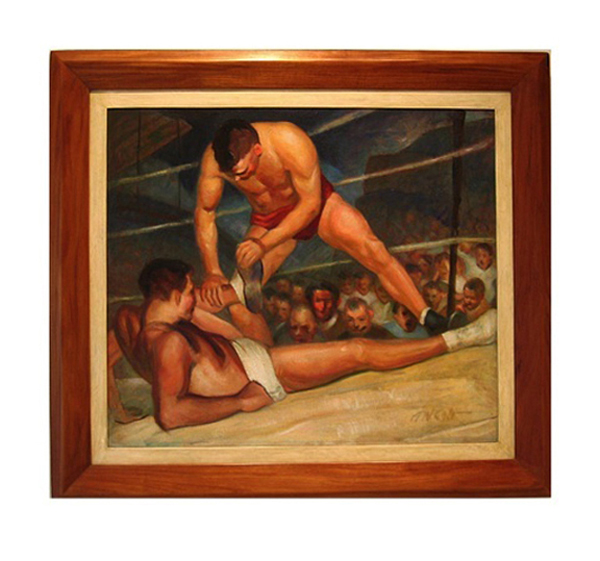
Arthur N. Colt, “The Wrestlers”, Oil on canvas c. 1938
ARTHUR N. COLT (1889-1972) USA
The Wrestlers c. 1938
Oil on canvas
Signed: A. N. Colt in lower right corner
For more information on Colt see: Who Was Who in American Art (Madison, Conn.: Sound View Press, 1985). p.125. Hove, Arthur, ed. Wisconsin Alumnus Vol. 61, No. 9 (January 1960), “Portrait Patterns” Art Digest v. 9 (December 15, 1934) p. 7
Canvas: H: 29 ½” x W: 34”
Framed: H: 38 ½” x W: 43”
Arthur Colt studied painting at the Art Institute of Chicago and in Paris. He was not only an important Wisconsin painter but also an influential teacher. He taught at the University of Wisconsin, Madison, founded a summer art colony at Black River and Devil’s Lake, WI and went on to form the Colt School of Art. Arthur Colt exhibited at the Madison Salon of Art Exhibition in 1934.
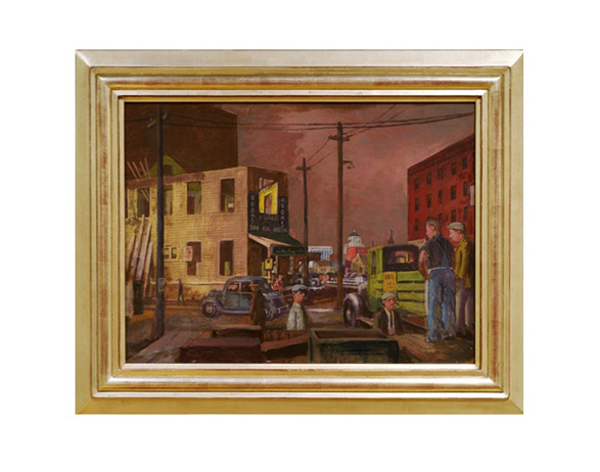
Gerrit V. Sinclair “Third Ward Milwaukee”, Oil on board, lemon gold frame c. 1940
GERRIT V. SINCLAIR (1890-1955) USA
Third Ward Milwaukee c. 1940
Oil on board, lemon gold frame
Signed: GV Sinclair (lower right corner on front of painting)
For more information see: Who Was Who in American Art (Madison, Conn.: Sound View Press, 1985) p. 571.
Painting H: 15” x W: 20”
Framed H: 20 7/16” x W: 25 7/16”
Price: $27,500
Gerrit V. Sinclair was born in Grand Haven, Michigan in 1890. He studied art at the School of the Art Institute of Chicago from 1910 to 1915. His most well known teachers at the Art Institute were John Vanderpoel and John Norton. In 1917 the artist enlisted in the Army Ambulance Corps and served in northern Italy and Austria. Scenes from his experience abroad are recorded in his works of the early 1920s. Following the war, Sinclair settled in Milwaukee, Wisconsin, where he became a member of the faculty of the Layton School of Art upon the school’s founding in 1920. He continued to teach at the Layton School and at the Oxbow Summer School of Art in Saugatuck, Michigan until his retirement in 1954. Sinclair is recognized both as an important artist and teacher from the Great Lakes region. During his lifetime Sinclair’s paintings were exhibited at the Salon d’Automne in Paris, the Salon Printemps in Paris, the Pennsylvania Academy of Fine Arts, the National Academy of Design, the Whitney Museum in New York, the New York Watercolor Club, the Brooklyn Museum, the Corcoran Gallery of Art in Washington D.C., the Carnegie Institute in Pittsburgh, the Art Institute of Chicago and in many other museums and galleries. He received numerous prizes and commissions for his work including a W.P.A. mural commission for the Federal Building in Wassau, Wisconsin. Sinclair was a member of Wisconsin Painters & Sculptors, Wisconsin Federation of the Arts and the Wisconsin Painting Museum. His style is a blend of realism and Impressionism but is clearly modern in its abstract concern for composition and color. Sinclair is best known for his regionalist paintings of rural and urban Wisconsin. His farm scene entitled ”Spring in Wisconsin” was exhibited at the 1939 World’s Fair in New York. Gerrit V. Sinclair died in Milwaukee, Wisconsin in 1955.
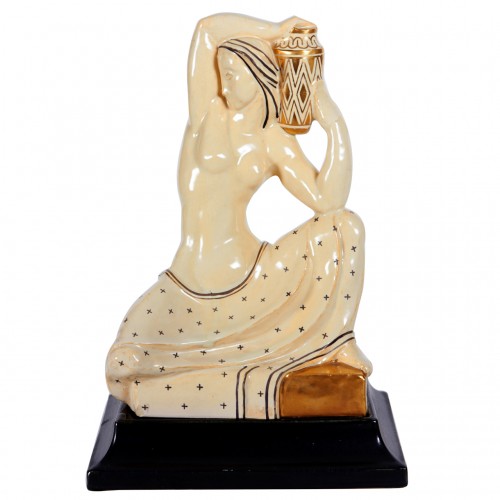
Walter Paul Suter, American Art Deco glazed pottery sculpture 1929
WALTER PAUL SUTER USA
AMERICAN ENCAUSTING TILING CO. New York, NY
Art Deco Seated Female Figure with Draped Skirt and Holding an Art Deco Vase 1929
Hand-modeled and molded cream glazed earthenware figure with gold and silver details on a separate, but matching black glazed earthenware base.
Signed: SUTER ‘29 (under glaze on back right hand corner)
H: 13″ x D: 7 1/2″ x W: 9″
Price: $14,500
Walter Paul Suter was born inBasel, Switzerland in 1902 and studied there at the School of Fine and Applied Arts. He moved to the United States in 1924 and settled in New York. He was a member of the American Ceramic Society, as well as the Society of Swiss Painters, Sculptors & Architects. In 1932 Suter won first prize in the Robineau Member Exhibition in Syracuse. He was a member of the American Encaustic Tiling Company in NYC.
Arrigo Varettoni de Molin, “Conflict”, Oil on canvas 1945
ARRIGO VARETTONI DE MOLIN (1902-1985)
Conflict 1945
Oil on canvas
Signed: de molin 1945 (lower left on front of canvas)
For more information see: Who’s Who in America, Series II, no. 11 (November 1, 1941) p. 6.
Canvas: H: 38” x W: 44”
Framed: H: 45 ½” x W: 51”
The work of Arrigo De Molin shows a genuine understanding of everyday people. His paintings have sympathy, humor and a touch of gentle irony. The artist himself, after immigrating to the United States from Borca di Cadore, Italy in 1921, had the opportunity to study art and design at Cooper Union and the Art Students’ League. His first enterprises as a theatrical designer and painter of community and church murals heavily influenced his later portrayals of New York City life. These, his most revered works, were exhibited at the Vendome Art Galleries in 1941. Later in life, de Molin, persevered as an independent artist, diversifying his talents to span design and invention.


 @hd_jewels