Product Description
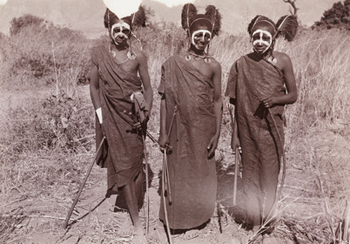
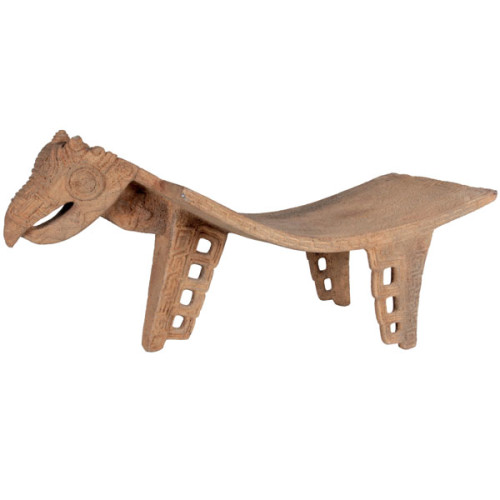
Tribal West African reliquary figures / sculptures, Gabon 20th Century

Tribal West African reliquary figures / sculptures, Gabon 20th Century
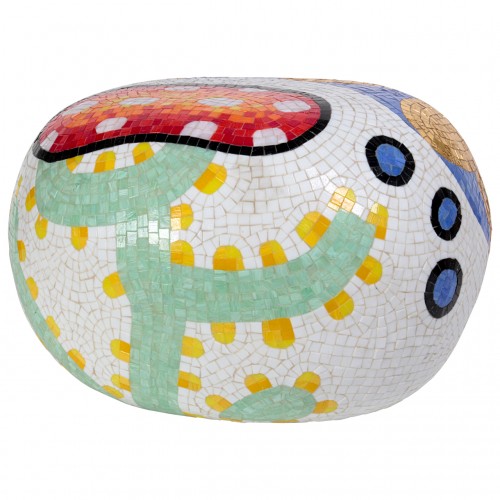
MARCEL WANDERS (1963-) The Netherlands
“One morning they woke up” mosaic occasional table or stool 2004
Gilt and lively colored glass mosaic, fiberglass body
H: 13″ x D: 17″
Price: $18,500
Marcel Wanders (1963) grew up in Boxtel, the Netherlands, and graduated at the School of the Arts Arnhem in 1988 with a cum laude certificate. He is now an independent industrial product designer operating out of Amsterdam where he has his own studio, Marcel Wanders studio. Marcel continues to work on diverse products and projects for Cappellini, Mandarina Duck, Magis, Droog Design and Moooi amongst others. For the latter he is associated as creative director. Marcel also co-operates in other design-related projects, such as the Vitra Summer Workshop where he was project leader for the second time. Also he was a juror for various prizes like the Rotterdam Design Prize (for which his own products were nominated several times) and the Kho Liang Ie prize. He lectured at SFMoMA, Limn the Design Academy and has taught at various design academies in the Netherlands. Marcel won the Rotterdam Design Prize (public prize) for the Knotted Chair, and received several other awards including the George Nelson Award (Interiors magazine) and Alterpoint Design Award 2000. In the 2001, Marcel has been nominated in the category ‘designer of the year’ in WIRED magazine’s 2001 wired rave awards. Designs of Marcel Wanders have been selected for the most important design collections and exhibitions in the world, like the Museum of Modern Art in New York and San Francisco, the Stedelijk Museum in Amsterdam, Museum Boijmans van Beuningen in Rotterdam, the Central Museum in Utrecht, and various Droog Design exhibitions. In the book ‘Wanders Wonders, design for a new age’ (1999) which accompanied a solo exhibition in Museum ‘t Kruithuis in Den Bosch, the most important products are shown, from the Knotted Chair to the Shadows lamps and from the Nomad Carpet to the Eggvase. Works of Marcel have been published in all leading design magazines.
BAKALOWITS & SÖHNE (founded 1845 in Vienna)
“Starburst” chandelier c.1970’s
Crystal rods of varying lengths with nine lights,
chromium-plated metal ceiling cap and spherical chandelier parts.
Ceiling to drop length: 46 1/2″ x overall diameter: 33 1/2″
Price: $24,000
The Bakalowits Company was founded in Vienna, Austria in 1845 by Elias Bakalowits. After his son Ludwig joined the company, E. Bakalowits & Sons grew and became one of the foremost crystal chandelier manufacturers in the Austro-Hungarian Empire. In 1892 Ludwig Bakalowits received the order to manufacture the chandeliers for the Neue Hofburg Palace in Vienna for Emperor Franz Joseph I and was appointed Imperial and Royal Purveyor to the Court.
The company’s reputation for excellence grew outside Europe, and by 1885 the company was exporting its products to America and Asia. In 1900, Bakalowits & Sons displayed their crystal chandeliers at the World Exposition in Paris. Other exhibitions in St. Petersburg, London, Geneva and Turin followed and attracted more clients from around the world. In 1928, the company obtained patents for its crystal chandeliers. In 1955 Bakalowits was entrusted with the manufacture of new lighting fixtures for some of the Viennese buildings that had suffered damage during the Second World War. These included the Parliament, the State Opera House, the National theatre, City Hall, St. Stephan’s Cathedral, and others.
AARON BOHROD (1907-1997) USA
F. CARLTON BALL (1911- 1992) USA
“Eve” vase 1952-56
Monumental glazed stoneware vase with a brown and cream beige glaze with sgraffito decoration of four stylized nudes.
Signed: A. Bohrod F.C. Ball (inscribed)
Illustrated: Aaron Bohrod: Figure Sketches, Edwin E. Elliott and Howard E. Wooden (Dodge City, Kansas: Gall and Shaull, 1990) p. 17, fig. 32. A Decade of Still Life: Aaron Bohrod (Madison, Wis.: University of Wisconsin Press, 1966) p. 41.
H: 20 3/4 x Dia: 12 1/2″
Price: $29,000
***Aaron Bohrod himself considered this vase his most important work in ceramic. This exact vase is illustrated in “A Decade of Still Life: Aaron Bohrod” in a bisque state. There is a stable firing crack that is visible on the base (see photo) near the Bohrod signature which happened in the firing, but in no way affects the structure of the piece. A letter from Aaron Bohrod himself describing this piece and the history surrounding it also accompanies the vase.
For more information see: The Potter’s Art in California: 1885-1955, Hazel V. Bray (Oakland: Oakland Museum Art Department, 1980) pp. 56-57.
A painter of cityscapes, landscapes and trompe l’oeil paintings, Aaron Bohrod lived in Chicago from birth until 1948, when he moved to Madison, Wisconsin. There he was a member of the University of Wisconsin’s art faculty. Bohrod was a graduate of the School of the Art Institute of Chicago, and he also attended the Arts Students League in New York.
Aaron Bohrod was an American artist who was nationally known in his lifetime. He was the subject of frequent exhibitions and gallery shows in various locations, generally focusing on a particular chronological period of his artistic production. The recipient of numerous prizes and awards (including two Guggenheims and the purchase prize at the “Artists for Victory” exhibition of 1942-43 at the Metropolitan Museum in New York), he was both proficient and prolific as a painter, sculptor, printmaker, ceramicist and as an illustrator. In addition, he was the author of several books on art and an autobiography. Although he studied at the Art Institute of Chicago and the Art Students League in New York with a number of well-known and influential teachers, the one who exerted the most profound influence on him was John Sloan, who taught him to value both the Old Masters and the visual reality of the urban American scene. Bohrod returned to Chicago after studying with Sloan in New York “determined to do in my own way with my own city what Sloan had done with New York.” (Bohrod’s stylistic development has been typically characterized in terms of his early relationship to the gritty urban realism of the Ashcan School with which Sloan was associated and his later magic realism style with its virtuoso and meticulous technique and witty visual repartee, almost as if they were two separate and unrelated developments. Although his own description of the origins of his unique still life approach in his autobiographical book, A Decade of Still Life, may have guided critics to look at his oeuvre in this way, a closer assessment reveals clear connections between the earlier and alter periods. Before 1940, for example, he had created a prototype of the still lifes that were to become his hallmark. By the mid 1950s, he began to dedicate himself to the creation of paintings that are by turns resonant, mysterious, evocative and humorous. The studied and careful detail of the bricks on the buildings foreshadow the care that Bohrod will lavish on each of the carefully observed and realized objects in his later still lifes, while the anecdotal detail predicts the accumulation of objects on which his later work depends. The polished and masterful technique of this later work also suggests the Old Masters to whom he was introduced by Sloan.
F. Carlton Ball (1911-1992)
F. Carlton Ball was born in Sutter Creek, California, He studied art at Sacramento Junior College before enrolling at USC. He graduated from the University of Southern California in 1933. He later did graduate studies under Glen Lukens at USC. He taught at several colleges/universities, such as the CCAC (his first position in 1935), Mills College, University of Wisconsin at Madison, University of Southern Illinois at Carbondale, USC University of Puget Sound and etc. From our research, we believe his last teaching position was in Tacoma, Washington, at the Tacoma Community College. Primarily known for his throwing, he did combine his pots with the decorative artistry of his first wife Kathryn Uhl Ball and most importantly, the Wisconsin artist, Aaron Bohrod. He exhibited at the Association of San Francisco Potters, 1952 Los Angeles County Fair’s 6000 Years Art in Clay and the Crocker-Kingsley of Sacramento, California, to mention a few locations. Exhibited at the Nationals in 1941-1949, 1951-1960 and 1966.