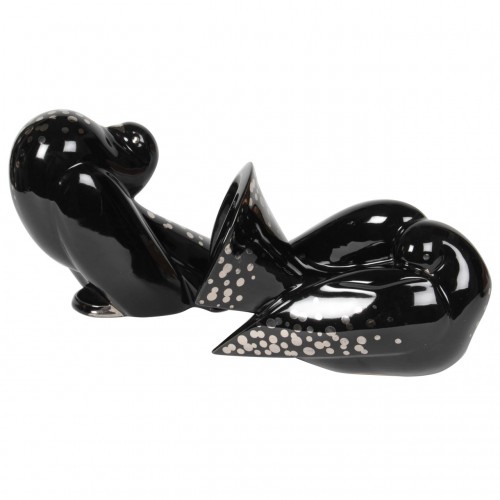
Jan et Joel Martel / Primavera French Art Deco Courting Fantail Pigeon Sculptures c.1930
JAN ET JOËL MARTEL (1896-1966) France
PRIMAVERA Paris
Pair of courting Faintail Pigeon Sculptures c.1925-30
Black glazed earthenware with silver / platinum decorative dot motif.
Marks: PRIMAVERA FRANCE, 12684
For related model: The Art Deco Style in Household Objects, Architecture, Scupture, Graphics, Jewelry, Theodore Menten (New York: Dover, 1972), p. 179.
For more information see: Joël et Jan Martel: sculpteurs 1896-1966, Christophe Vital, et al. (Paris: Gallimard / Electa, 1996), pp. 127-9
H: 8 1/16” x L: 9” x D at tail: 5 1/4”
H: 7 1/8” x L: 10” x D at tail: 5 1/4”
Jan & Joël Martel (the Martel Brothers/Twins, born in Nantes on 5 April 1896, both died in 1966)
The twin Martel sculptors were among the founding members of Union des Artistes Modernes, and their original works include ornamental sculptures, statues, monuments and fountains displaying characteristics typical of the Art Déco and Cubist periods. The brothers took part in a number of Paris exhibitions including the Salon des Indépendants, Salon d’Automne, Salon des Tuileries and the Exposition des Arts Décoratifs in 1925. In 1932, they created the Claude Debussy monument which sits on the boulevard Lannes in Paris. Between 1924-1926, Robert Mallet-Stevens designed a studio for the Martel twins at 10 Rue Mallet-Stevens in Paris’ 16th Arrondissement.
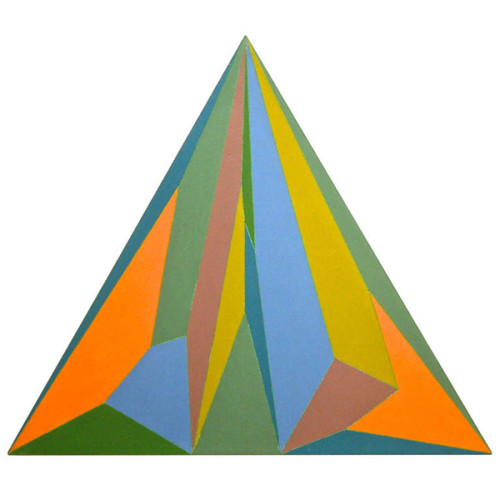
Peter Svenson, “Triangle Painting”, Oil on canvas 1976
PETER SVENSON (b. 1944)
“Triangle Painting” 1976
Oil on Canvas
Signed: Peter Svenson 1976, Turkey Shoot (on the stretcher) and canvas on verso.
H: 41 ½” x W: 48”
Nationally recognized artist and writer Peter Svenson was born in 1944 and received a bachelor of arts degree from Tufts University and a masters of fine arts in painting from the University of North Carolina.
Svenson created “Turkey Shoot” in 1976 based on color field painting theories. The triangular shaped canvas is unusual in this style of painting, the lines are precise, the paint is thinly laid on the primed canvas in flat primary and secondary colors. “During the late 1950s and 1960s, color field painters emerged in Great Britain, Canada, Washington, DC and the West Coast of the United States using formats of stripes, targets, simple geometric patterns and references to landscape imagery and to nature.” Some of the artists of the Washington Color School included Gene Davis, Morris Louis, Kenneth Noland and Sam Gilliam.
Peter Svenson’s work relates to this group of Washington color field artists working in the style in the 1950s, 60s and 70s.
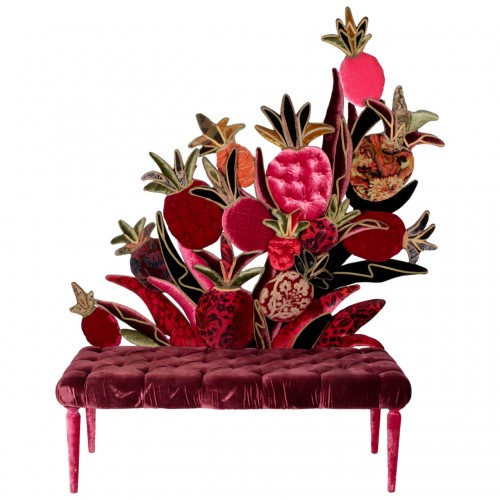
Exotic variety of silk and cut silk velvets sewn and sculpted in the form of a spray of various pineapple shapes on a tufted cushion seat and upholstered legs.
Marks: Tolomeo (written on the velvet), Tolomeo script signature (brass plaque)
Exhibited: Fondazioni Cerratelli, Pisa, Italy, Summer 2006
Model illustrated and biographical information on Carla Tolomeo: Il Fogliaccio, July 7th, 2006
For further information see: Carla Tolomeo Mai Sedersi Sugli Allori, Never rest on your laurels 1995-2004, Carla Tolomeo (Milano 2004)
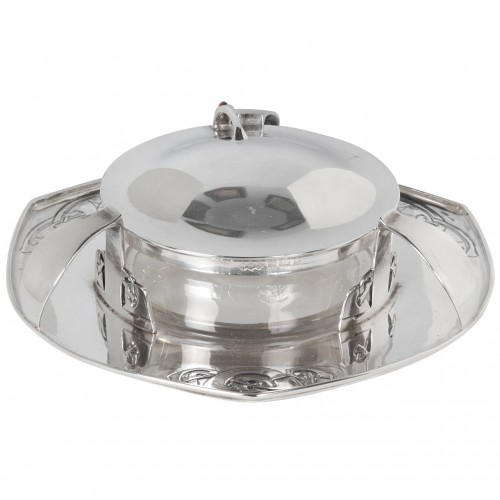
Archibald Knox / Liberty & Co. Rare Sterling and Opal caviar server 1904
ARCHIBALD KNOX (1864-1933) UK
LIBERTY & COMPANY London, UK
Cymric tri-handled covered server 1904
Sterling silver with repoussé Celtic knot motifs and three buttress handles; the handle of the domed lid inset with a jelly opal, cylindrical crystal bowl.
Marks: No. 5199, Liberty & Co., CYMRIC and Birmingham assay marks for 1904 (all the marks appear both on the underside of the base and on the cover)

 @hd_jewels